PlayStation: How a $1 CD-ROM Toppled Nintendo's Empire — The Console Born from Public Humiliation and a Three-Second Speech ('299')
On May 11, 1995, at the inaugural Electronic Entertainment Expo (E3) in Los Angeles, Sega thought it had just pulled off a masterstroke.
On stage, Sega announced that its next-generation console, the Sega Saturn, was already shipping to select US retailers that very morning—at $399.
Then Sony Computer Entertainment America president Steve Race walked up to the podium to deliver Sony’s keynote. The room expected twenty minutes of corporate slides. Instead, Race leaned into the microphone, uttered a single number—
“299.”
—and walked straight off the stage without another word. The auditorium erupted. In three seconds, Sega’s launch was dead in the water.
That small gray box, which had debuted in Japan on December 3, 1994 as the PlayStation, went on to sell 102.49 million units worldwide—becoming the first home video game console in history to cross the 100-million mark.
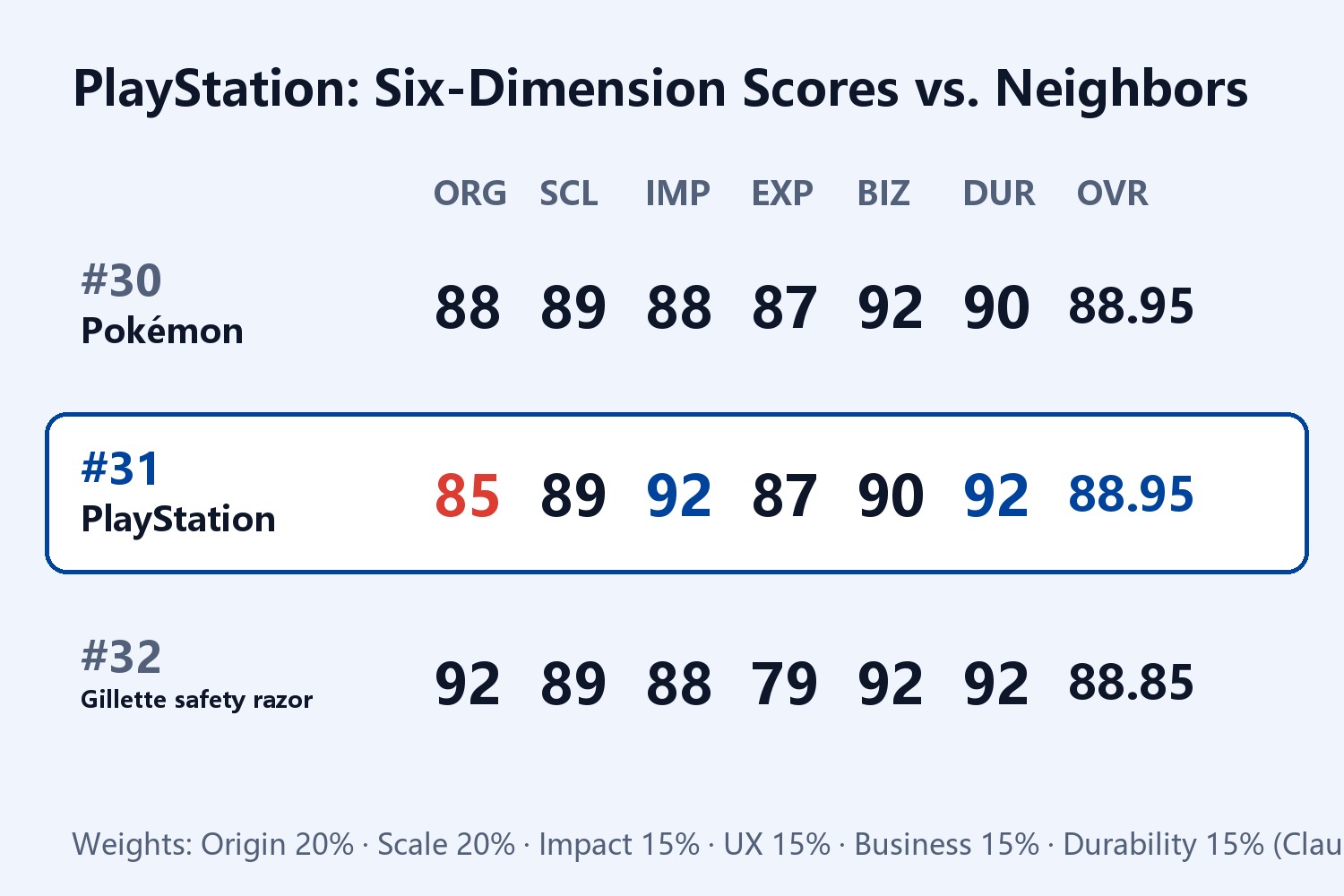
On our 100 Products That Changed the World ranking, PlayStation (1994) ranks #31 with an overall score of 88.95 (evaluated by Claude AI across six weighted dimensions): Impact 92, Durability 92, Business 90, Scale 89, Experience 87, and Originality 85.
It ties at 88.95 with #30 Pokémon (1996) and sits just ahead of #32 The Gillette Safety Razor (OVR 88.85). Meanwhile, its creator, Ken Kutaragi, ranks #32 on our 100 Product Managers Who Changed the World board (OVR 90.20).
Seeing #30 Pokémon and #31 PlayStation side by side captures the great fork in the road of 1990s gaming: while Pokémon saved Nintendo’s handheld empire on a monochrome screen by wiring elementary school friendships into a link cable, PlayStation dismantled Nintendo’s home-console monopoly with a $1 plastic disc and a ten-year older demographic.
1. The 1991 Chicago Betrayal: A Product Born Out of Public Humiliation
Sony never intended to build its own video game console. Originally, “Play Station” (with a space in the middle) was a joint venture with Nintendo.
In the late 1980s, Sony engineer Ken Kutaragi secretly designed the legendary SPC700 sound chip for Nintendo’s Super Famicom (SNES). He then convinced Sony and Nintendo to partner on a CD-ROM add-on and hybrid console called the Play Station.
In June 1991, Sony proudly unveiled the Play Station at the Consumer Electronics Show (CES) in Chicago.
The very next morning, Nintendo president Hiroshi Yamauchi sent his son-in-law Minoru Arakawa onto the CES stage to announce a bombshell: Nintendo was ditching Sony to partner with Sony’s European arch-rival, Philips.
Yamauchi had read the fine print of Sony’s contract and realized Kutaragi had structured it so Sony would control licensing on all CD-ROM software titles. Nintendo had no intention of handing the keys of its tollbooth to a hardware supplier.
Humiliated in front of the global press, most of Sony’s board wanted to kill the gaming project immediately. After all, Sony made Trinitron TVs and Walkmans—not “toys.”
Kutaragi refused to back down. He argued that if Sony folded after being publicly humiliated by Nintendo, Sony would never be respected in digital entertainment again. Sony president Norio Ohga backed his fiery engineer with two words: “Do it.”
Crucially, Ohga shielded Kutaragi’s team from Sony’s conservative electronics bureaucracy by housing the new division—Sony Computer Entertainment (SCE)—under Sony Music. That organizational move changed everything: instead of treating games like transistor radios, SCE treated game developers like recording artists and discs like albums.
2. Why a $1 CD-ROM Destroyed a $15 Cartridge
Gamers remember the PlayStation for its 3D polygons, Ridge Racer, and Tomb Raider. Game publishers, however, defected to PlayStation because of brutal supply-chain math.
Under Nintendo’s cartridge regime, third-party publishers like Square and Capcom bore crushing financial risk:
- Massive Upfront Working Capital & Inventory Risk: Silicon mask-ROM cartridges cost roughly $15 to $20 per unit in manufacturing fees and royalties paid up front to Nintendo, with lead times of 8 to 12 weeks. If a game flopped, a publisher could go bankrupt sitting on a warehouse of $15 plastic bricks; if a game was a surprise hit, re-ordering more cartridges took months—missing the Christmas window entirely.
- Tiny Storage Ceilings: An expensive cartridge held 8MB to 32MB, choking off full-motion video, voice acting, and orchestral scores.
PlayStation’s CD-ROM blew that economic model apart:
- 650MB of Space: Twenty times the capacity of a cartridge, enabling full-motion CGI cutscenes, CD-quality music, and sprawling worlds.
- $1 Manufacturing Cost: Pressing a CD at Sony Music’s existing plants cost under $1, and Sony charged significantly lower royalties than Nintendo.
- 7-Day Re-Orders: A publisher could press a cautious initial run of 50,000 discs, see it sell out over the weekend, and have Sony Music press and ship 100,000 more discs to store shelves within seven days.
When Nintendo stubbornly stuck with cartridges for the Nintendo 64 in 1996, Square made the historic decision to move Final Fantasy VII—which required three full CDs—exclusively to the PlayStation. Enix (Dragon Quest VII), Capcom (Resident Evil), and Konami (Metal Gear Solid) followed suit. Sony didn’t just build a faster chip; it liberated third-party publishers from inventory Russian roulette.
3. Aging Up the Player by a Decade: From Toy Store to Nightclub
Before 1994, video game consoles were marketed primarily to 10-year-olds.
Sony realized that the kids who grew up playing the 1983 NES were now 20 to 26 years old. They had jobs, disposable income, and apartments—and they didn’t want to buy a machine that looked like a Fisher-Price toy.
Everything about the PlayStation was engineered to signal adulthood:
- Teiyu Goto’s Iconic Geometry (
△ ○ × □): Instead of letters of the alphabet, Sony’s controller used four geometric symbols with distinct meanings—Green Triangle for viewpoint/direction, Red Circle for Yes, Blue Cross for No, and Pink Square for a sheet of paper (menus). - Marketing in Nightclubs: In Europe, Sony installed PlayStation pods inside London’s trendiest rave clubs like Ministry of Sound, pairing the console with the electronic soundtrack of WipEout.
- The Memory Card Ecosystem: Because CD-ROMs were read-only, players needed external 128KB Memory Cards to save their progress—turning a technical limitation into a high-margin accessory and a social ritual as friends carried their save files in their pockets from house to house.
4. Why Impact and Durability Both Score 92
PlayStation scores 92 in Impact, 92 in Durability, and 90 in Business because the blueprint it established in 1994 still governs the console industry thirty-two years later:
- The DualShock Controller Layout (1997): Twin thumbsticks, four shoulder triggers (
L1/L2/R1/R2), and dual rumble motors became the permanent physical grammar of 3D gaming across PlayStation, Xbox, and Nintendo Pro controllers alike. - Unbroken Numbered Lineage: From PS1 to PS2 (the best-selling console of all time at 160M units) through PS3, PS4, and PS5, PlayStation became the single most durable hardware brand in entertainment—and the profit engine of all of Sony Corporation.
Further Reading
- 100 Products That Changed the World (Full Ranking)
- 100 Product Managers Who Changed the World (Full Ranking)
- Ken Kutaragi (#32): Humiliated by Nintendo, He Built PlayStation Against All of Sony
- Pokémon (#30): Turning a Link Cable into History’s Highest-Grossing IP
- Steam (#43): How a Hated Forced Updater Became PC Gaming’s Cash Register
Discussion