AI & The New Social Contract | When Productivity Is Infinite, Humans Deserve Joy, Not New Shackles: Why Universal Basic Income (UBI) Is a Fundamental Right
Yesterday we broke down Anthropic’s historic S-1 IPO filing: a company barely five years old generated $16.286 billion in the first half of 2026 alone — growing 400x in three and a half years — because autonomous agents like Claude Code can now execute software engineering work that previously required an entire ten-person team.
Behind Wall Street’s euphoria lies a question that keeps millions of engineers, office workers, designers, and parents awake at night: “If one AI agent burning a few million tokens can do the work of ten people, what happens to the other nine? How do they pay their mortgage, buy groceries, or raise their children?”
Pause for a moment and examine the premise of that fear. Isn’t it utterly absurd?
Imagine a time traveler from 1826 arriving in 2026. You tell them: “Great news! Humanity has built tireless artificial intelligence and autonomous machines that can write software, diagnose diseases, translate languages, and manufacture goods at near-zero marginal cost. Human productivity has exploded beyond our wildest dreams!”
That traveler would leap for joy: “Wonderful! Since machines now do the heavy lifting and abundance is everywhere, surely every human in 2026 works only two hours a day, lives free from poverty, and spends their days with family, creating art, exploring nature, and enjoying life!”
Instead, we live in a paradox where the faster productivity explodes, the more terrified ordinary people become of losing their 50-hour-a-week cubicle grind.
Extreme abundance of productivity should be humanity’s greatest blessing. Allowing 19th-century distribution rules to turn AI abundance into unemployment terror and new survival shackles would be a failure of civilization.
Today we launch our daily column on UBI (Universal Basic Income) & AI’s Reconstruction of Human Society. Our core conviction is simple:
AI is fundamentally reconstructing human society. When productivity reaches extreme abundance, we must establish a new social contract centered on Universal Basic Income (UBI) and a Public Compute Dividend — unconditionally guaranteeing every human being’s basic right to survive and thrive, so humanity enjoys the joy of abundance rather than wearing it as a shackle.
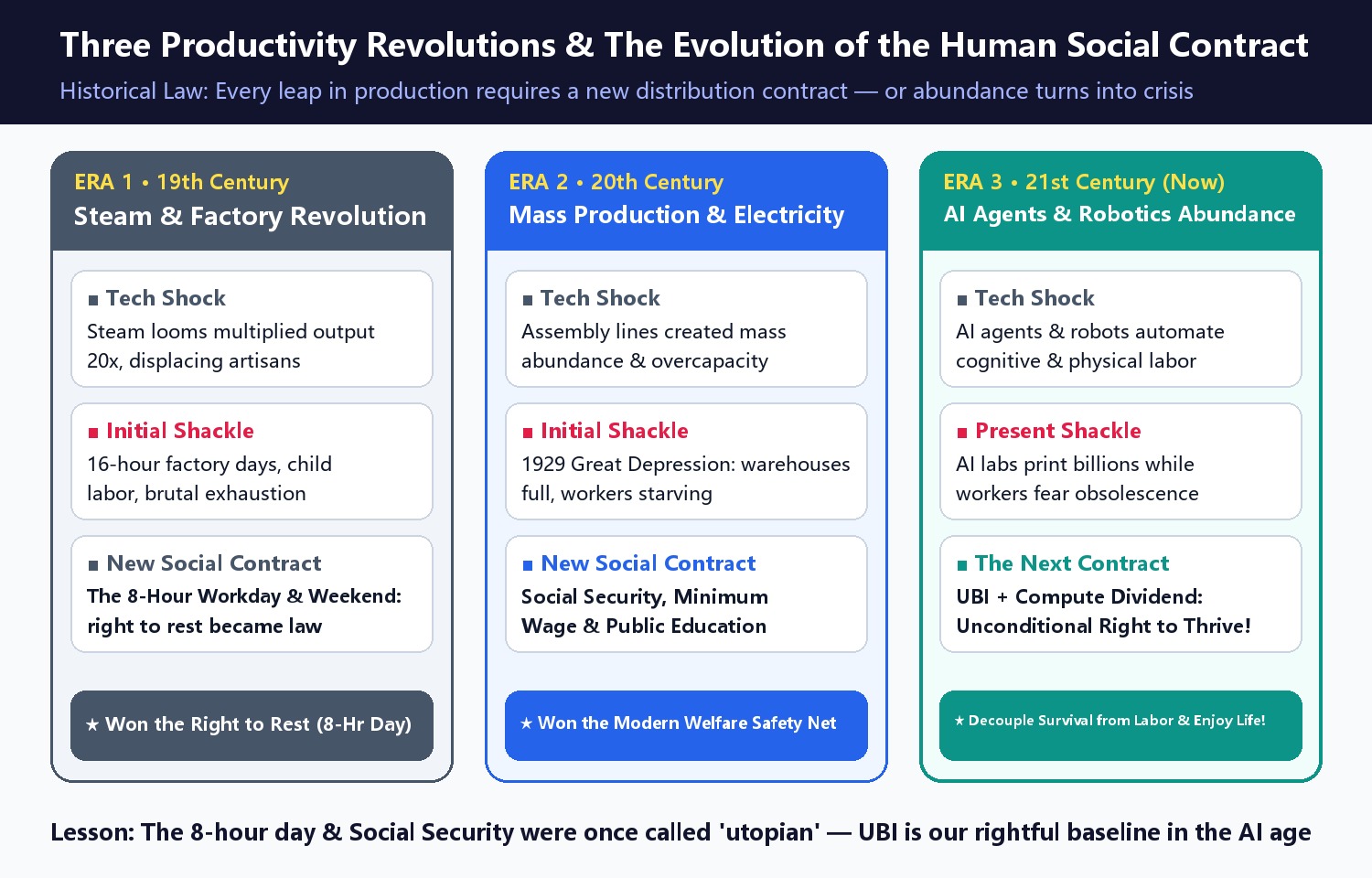
1. The Iron Law of History: The 19th Century Invented the 8-Hour Day, the 20th Invented Social Security, and the 21st Must Invent UBI
Whenever Universal Basic Income (UBI) — an unconditional, regular cash dividend paid to every citizen to cover basic food, housing, and dignity — enters public debate, critics reflexively scoff: “Free money for existing? That’s a utopian fantasy that will make everyone lazy!”
Those critics forget that every single pillar of modern human dignity — the weekend, the 8-hour workday, child-labor bans, public education, and Social Security pensions — was once denounced by 19th-century factory owners as “utopian madness that will ruin the economy.”
Look at the last 200 years of economic history and an iron law emerges: every exponential leap in productivity initially triggers a crisis of abundance, until humanity writes a new social contract.
Era 1 (19th-Century Steam & Mechanization): Winning the Right to Rest
When steam engines and power looms multiplied textile output 20-fold, workers were initially chained to factory floors for 14 to 16 hours a day, six days a week, alongside seven-year-old child laborers. It took decades of reform to establish the first industrial social contract: child labor abolition, the 8-hour workday, and the two-day weekend.
Era 2 (20th-Century Electrification & Assembly Lines): Winning the Modern Safety Net
When Henry Ford’s assembly lines and electric grids multiplied manufacturing output again, the result in 1929 was the Great Depression: warehouses overflowed with unsold goods while unemployed workers starved in breadlines because purchasing power had collapsed. Society responded with the second great social contract: Social Security, minimum wage laws, unemployment insurance, and universal public schooling.
Era 3 (21st-Century AI Agents & Robotics): Decoupling Survival from Wage Labor
The first two industrial revolutions automated human muscle, allowing workers to migrate into cognitive office jobs. Today, frontier AI models and embodied robotics automate both cognitive and physical labor simultaneously, while the cost per token falls by ~90% every year.
When selling hours of routine mental or physical labor is no longer scarce, tying a human being’s right to eat and have shelter strictly to full-time wage employment becomes mathematically obsolete. The 21st-century social contract must decouple basic survival from wage labor through UBI.
2. Where Does the Money Come From? The Public Knowledge Commons & The Compute Dividend
The second knee-jerk objection to UBI is fiscal: “How do we pay for it without printing money and causing inflation?”
The answer is right inside Anthropic’s S-1 prospectus and the trillion-dollar balance sheets of the AI hyperscalers: from the massive productivity surplus generated by AI — funded via a Universal Compute & Token Dividend.
Ask a basic property-rights question: Who actually trained frontier AI models?
Did a handful of Silicon Valley executives personally write the trillions of words of books, scientific papers, journalism, medical case studies, open-source GitHub repositories, and human conversations that taught Claude, GPT, and DeepSeek how to reason and code?
No. Frontier AI was trained on the cumulative intellectual heritage of all humanity across thousands of years. Without the public commons of human language, science, and code, a $100 billion GPU cluster is nothing more than an expensive space heater.
Since 1982, the State of Alaska has operated the Alaska Permanent Fund, paying every resident — man, woman, and child — an unconditional annual dividend of $1,000 to $3,200+ because the oil beneath Alaska belongs to all citizens in common.
In the 21st century, humanity’s collective knowledge and AI compute infrastructure are our shared oilfield. As global enterprise AI token consumption and robotic output scale into the tens of trillions of dollars, a modest Compute & Robotics Dividend (Token Tax) — combined with replacing sprawling, bureaucratic welfare means-testing — can fund an unconditional basic income floor for every citizen without printing a single inflationary dollar.
3. Henry Ford’s Law: Without Human Purchasing Power, Who Buys What AI Produces?
Even if you set aside ethics and human rights, pure macroeconomic math makes UBI inevitable.
In 1914, Henry Ford doubled his factory workers’ pay to $5 a day and cut shifts from nine hours to eight. When Wall Street accused him of throwing away profits, Ford stated a truth that every AI executive should tattoo on their wall: “If my workers cannot afford to buy the cars they make, who is going to buy my cars?”
AI agents and humanoid robots have one fatal flaw as economic participants: AI agents do not eat dinner, rent apartments, buy sneakers, go to concerts, or take family vacations.
An economy requires both production and consumption. If autonomous agents replace 50% of wage labor and all cost savings accrue to capital owners, aggregate consumer demand collapses into a deflationary spiral. UBI is not charity; it is the macroeconomic circuit-breaker that keeps an ultra-high-productivity economy alive.
4. Reclaiming Human Joy: Abundance Should Feel Like Freedom
For two centuries, industrial conditioning taught us to equate human worth with exhaustion — as if a life not spent commuting in traffic, dreading Monday mornings, and formatting spreadsheets for ten hours a day is somehow immoral.
That is a lie. Human beings were born to experience wonder, love, curiosity, family, art, and joy — not to serve as biological middleware for corporate workflows.
Empirical trials from Finland, Canada, Kenya, and Sam Altman’s own three-year OpenResearch UBI study have repeatedly shown that when people receive unconditional basic security, they do not become couch potatoes. Anxiety and depression plummet; entrepreneurship, further education, caregiving for children and aging parents, and creative work rise.
Now that AI and machines can carry the burden of routine production, it is time for human institutions to catch up with human technology.
Productivity is abundant. Let us build a world where every human being shares in the joy of that abundance.
(This is Episode 01 of our daily column on UBI & AI’s Reconstruction of Society. Tomorrow in Episode 02, we examine the hard data from OpenResearch’s 3-year UBI study backed by Sam Altman: what actually happens when people receive unconditional cash every month?)
Discussion