Marc Benioff: Putting 'No Software' on a Badge — The Oracle Prodigy Who Hired Fake Protesters and Turned Enterprise Software into a Utility
In February 2000, a noisy crowd of protesters suddenly materialized outside San Francisco’s Moscone Center.
Inside, enterprise software giant Siebel Systems was hosting its flagship user conference. As corporate executives stepped onto the sidewalk, dozens of demonstrators waved picket signs in their faces: “The End of Software!” “Software Is Obsolete!” A local television news crew was already on the scene, cameras rolling and microphones thrust forward—until attendees realized that not only were the protesters paid actors, the TV crew was fake too.
Watching gleefully from across the street was the man who paid for the whole spectacle. Everyone who walked past was handed a metal pin bearing the word “Software” inside a red circle with a slash through it.
His name was Marc Benioff. He was 35 years old, and his startup, Salesforce, was barely a year old.
To Silicon Valley incumbents at the time, it looked like a cheap publicity stunt by a carnival barker who couldn’t compete on engineering. Looking back twenty-five years later, those picket signs outside Moscone Center were not a joke—they were a death certificate. The era of shipping enterprise software on CD-ROMs, charging $2 million up front for perpetual licenses, and billing six months of consultant hours just to make it boot was over. Benioff killed it.
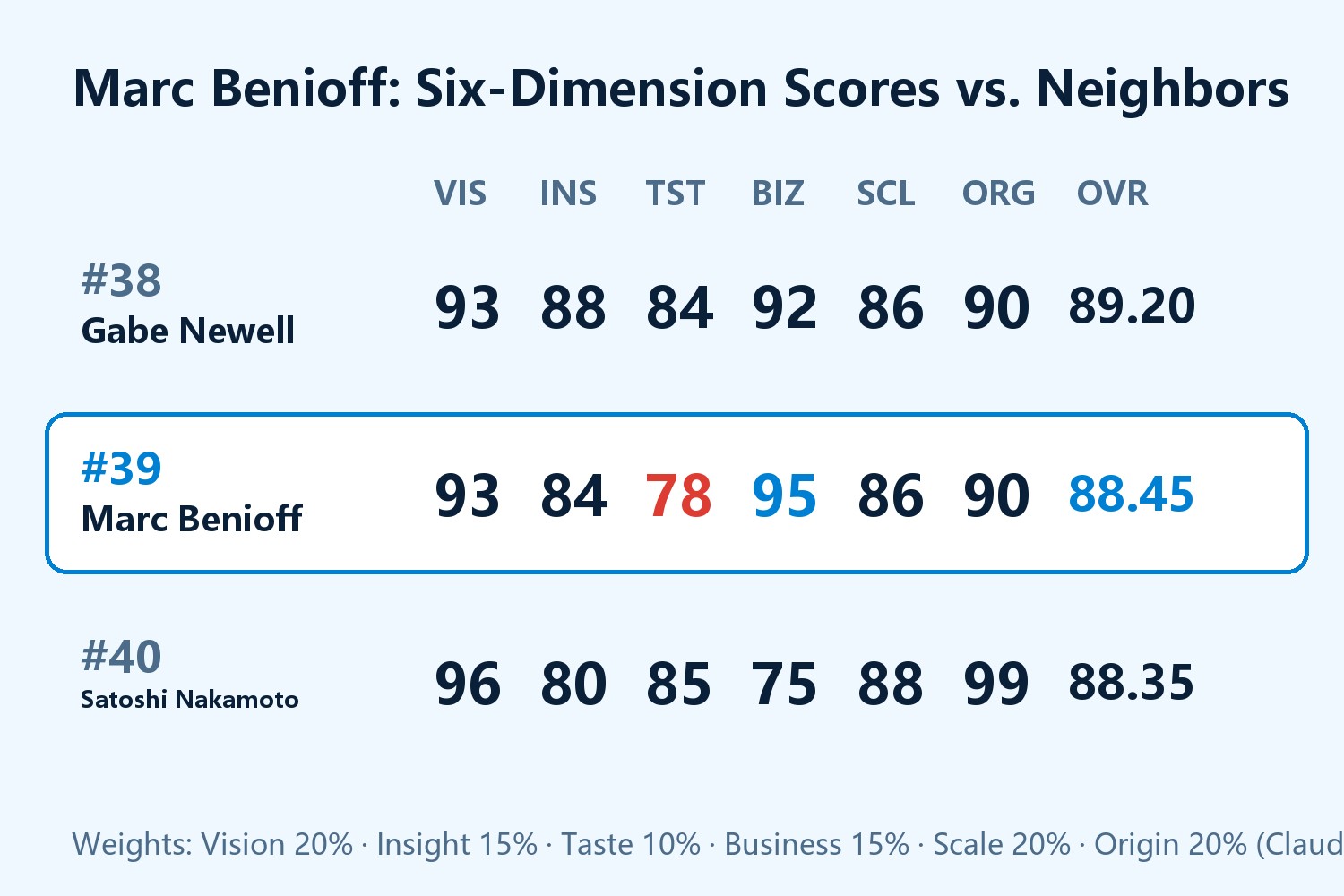
On our 100 Product Managers Who Changed the World ranking, Marc Benioff ranks #39 with an overall score of 88.45 (evaluated by Claude AI across six weighted dimensions): Business 95, Vision 93, Origin 90, Scale 86, Insight 84, and Taste 78.
He sits just behind #38 Gabe Newell (OVR 89.20) and just ahead of #40 Satoshi Nakamoto (OVR 88.35). Pairing Newell and Benioff reveals an uncanny historical rhyme: between 1999 and 2003, Newell took boxed PC games off retail shelves and turned them into Steam, while Benioff took enterprise software out of corporate server rooms and put it inside a web browser. Both men executed the exact same structural move—delete the disc in the middle, and turn software into a living service.
1. Writing Atari Games at 15, Interning for Steve Jobs, and Becoming Oracle’s Youngest VP at 26
Because Benioff is one of the loudest showmen in tech history, people often forget that he started out as a teenage programmer.
Born in the San Francisco Bay Area in 1964, Benioff was writing and selling games for the Atari 800 by age 15. His bedroom company, Liberty Software, published titles like Crypt of the Undead and King Arthur’s Heir, earning him $1,500 a month in royalties—enough to pay his own way through the University of Southern California.
In the summer of 1984, a 20-year-old Benioff landed an internship writing assembly language in Apple’s Macintosh division. It was the height of Steve Jobs’s pirate-flag era. What Benioff absorbed at Apple wasn’t just software craft; it was Jobs’s habit of starting with the narrative—defining who the villain is and why the old world must end—before shipping the product.
After graduating from USC, Benioff joined Oracle under Larry Ellison.
He stayed for thirteen years. Named Rookie of the Year at 23, he became the youngest vice president in Oracle’s history at 26, pulling in over $1 million a year. Ellison treated the towering, charismatic young executive like a protégé.
Yet those thirteen years inside the belly of the enterprise software beast showed Benioff the industry’s dirty secret.
In the late 1990s, buying CRM or ERP software from Siebel, Oracle, or SAP meant signing a multi-million-dollar license check up front, buying racks of Sun Microsystems servers, and hiring an army of systems integrators for twelve months. By the time the software went live, the company’s sales process had already changed. Worse still, the vendor’s incentives were completely broken: once the software company cashed the seven-figure upfront check, it had already won—whether anyone at the customer’s company ever logged in or not.
2. A Sabbatical in India and the Amazon Epiphany: Why Can’t Enterprise Software Work Like Buying a Book?
Burned out after a decade at Oracle, Benioff took a sabbatical with Ellison’s blessing, spending time in Hawaii and traveling through India.
Stepping away from Oracle’s quarterly sales grind allowed a simple product question to crystallize in his mind. By 1998, anyone could open a browser, go to Amazon, buy a book in thirty seconds, or check Yahoo! Mail from any computer on earth—without installing a CD-ROM, calling an IT administrator, or hiring Accenture.
“Why are we still delivering business software the way we did in the 1980s?”
In March 1999, Benioff teamed up with Parker Harris and two other co-founders in a rented Telegraph Hill apartment in San Francisco to build Salesforce. Even Larry Ellison wrote a $2 million personal check to back him.
Benioff’s product brief to Parker Harris was dead simple: make managing sales leads look and feel as effortless as shopping on Amazon.com—inside a browser, with zero installation.
3. The Three Decisions That Built the SaaS Playbook: Multi-Tenancy, $50/Month, and “Customer Success”
Today, SaaS (Software as a Service) is the default operating model of the software industry. In 1999, Benioff and Harris had to invent its core mechanics from scratch:
1. True Multi-Tenancy: Everyone Lives in the Same Apartment Building
Early “application service providers” (ASPs) in the dot-com era simply hosted separate single-tenant servers for each client in a data center. Every time the vendor updated the code, engineers had to patch hundreds of isolated instances by hand.
Parker Harris insisted on multi-tenant architecture: every customer—from a five-person startup to a Fortune 500 bank—ran on the exact same codebase and shared database schema, logically separated by tenant IDs. When Salesforce shipped its three annual releases (Spring, Summer, Winter), every customer in the world woke up on Monday morning running the newest version simultaneously. Version fragmentation disappeared overnight.
2. $50 per User per Month: Turning CapEx into a Credit Card Swipe
Instead of charging $500,000 up front and requiring a six-month CIO approval cycle, Salesforce launched at $50 per user per month, with the first five users free.
A regional VP of Sales didn’t need permission from IT or the CFO; they could pull out a corporate credit card, sign up their team in five minutes, and expense it. What Silicon Valley later christened Bottom-Up Adoption and Product-Led Growth (PLG) started right here.
3. The 8% Monthly Churn Crisis That Invented “Customer Success”
Subscriptions cut both ways: when switching costs are zero, unhappy customers simply stop paying next month.
Around 2004, Salesforce realized that while new bookings were growing fast, monthly logo churn was hovering near a terrifying 8%—enough to bleed out almost the entire customer base every year.
Benioff realized that in a subscription business, closing the deal is not the finish line; it’s day one. If users weren’t logging in by month two, they would cancel by month four. In 2005, he created an entirely new corporate function that reported neither to sales nor to break-fix support: Customer Success. Its sole job was to monitor product adoption telemetry and proactively coach customers into getting value before renewal day arrived.
4. Shipping AppExchange Three Years Before the iPhone App Store
By 2005, Salesforce hit a classic enterprise wall: every large company wanted custom objects, industry-specific workflows, and bespoke integrations. Building all of them into the core product would turn the multi-tenant codebase into an unmaintainable monster; refusing them meant losing enterprise deals.
Benioff and Harris solved it by opening up the underlying metadata layer as a platform (Force.com) and launching a marketplace where third-party developers could build and sell add-on apps.
Benioff originally named this marketplace the App Store and even registered the domain appstore.com in 2005 before launching the product as AppExchange. Three years later, in 2008, when Steve Jobs unveiled the iPhone App Store on stage, Benioff—sitting in the audience—walked up afterward and gifted his former boss and mentor the appstore.com domain and trademark out of gratitude.
AppExchange turned Salesforce from a replaceable CRM form into an immovable enterprise operating system—earning Benioff a 95 in Business.
5. Why His “Taste” Score Is Only 78
Across our six dimensions, Benioff scores like a titan in Business (95), Vision (93), and Origin (90)—yet his Taste score is 78, pulling his overall rating to 88.45 just behind Gabe Newell.
Anyone who has actually worked as a sales rep typing call notes into Salesforce knows why. For decades, its interface has been famously dense, cluttered, slow, and over-engineered—requiring certified administrators just to configure page layouts. And over the past decade, Salesforce has relied heavily on growth by checkbook—acquiring ExactTarget, MuleSoft ($6.5B), Tableau ($15.7B), and Slack ($27.7B)—often leaving customers with stitched-together products that feel like separate companies sharing a login screen.
Yet Benioff understood a ruthless truth about B2B software: the person who suffers through the UI (the sales rep) is not the person who signs the contract (the CRO and CEO). Executives don’t buy CRM for minimalist typography; they buy it for pipeline visibility, permissions, auditability, and ecosystem lock-in.
6. Epilogue: When AI Threatens the “Per-Seat” Model He Invented
Twenty-five years after Benioff taught the software world to charge per human seat per month, AI agents are threatening to shrink the number of human seats companies need.
True to form, Benioff didn’t wait to be disrupted. With Agentforce, he has begun pivoting Salesforce from per-seat licensing toward outcome- and conversation-based pricing ($2 per AI conversation), while publicly trashing Microsoft’s Copilot as “the new Clippy.”
Love or hate the theatrics, every monthly subscription on your credit card statement—and every SaaS pitch deck measuring ARR and Net Dollar Retention—lives in the world Marc Benioff built when he handed out those little “No Software” badges on a San Francisco sidewalk.
Discussion