Satoshi Tajiri: Putting a Childhood Forest Inside a Link Cable — How a Bug-Obsessed Outsider Built the Highest-Grossing IP in Human History
In Tokyo in 1990, 25-year-old independent game designer Satoshi Tajiri stared at two Game Boy handhelds tethered together by a black plastic cord, and a strange image flashed through his head:
A tiny insect was crawling out of one screen, traveling along the copper wire, and emerging inside the other screen.
That cord—the Game Link Cable—had been shipped alongside the original Game Boy in 1989 by Nintendo hardware legend Gunpei Yokoi (#36). At the time, 99% of the industry treated the cable as a dueling rope: you plugged it in so two players could dump garbage blocks on each other in Tetris or beat each other in tennis.
Only Tajiri, a boy who had grown up obsessed with catching beetles in the woods, saw something completely different: the wire wasn’t meant for fighting. It was meant for trading.
Six years later, on February 27, 1996, two unassuming monochrome cartridges—Pocket Monsters Red and Green—quietly hit shelves for an aging Game Boy platform that even Nintendo executives thought was on its last legs. What followed rewrote entertainment history: those capsule creatures single-handedly resurrected the Game Boy and grew into the highest-grossing media franchise in human history, generating over $150 billion in lifetime revenue—surpassing Mickey Mouse, Star Wars, and Marvel.
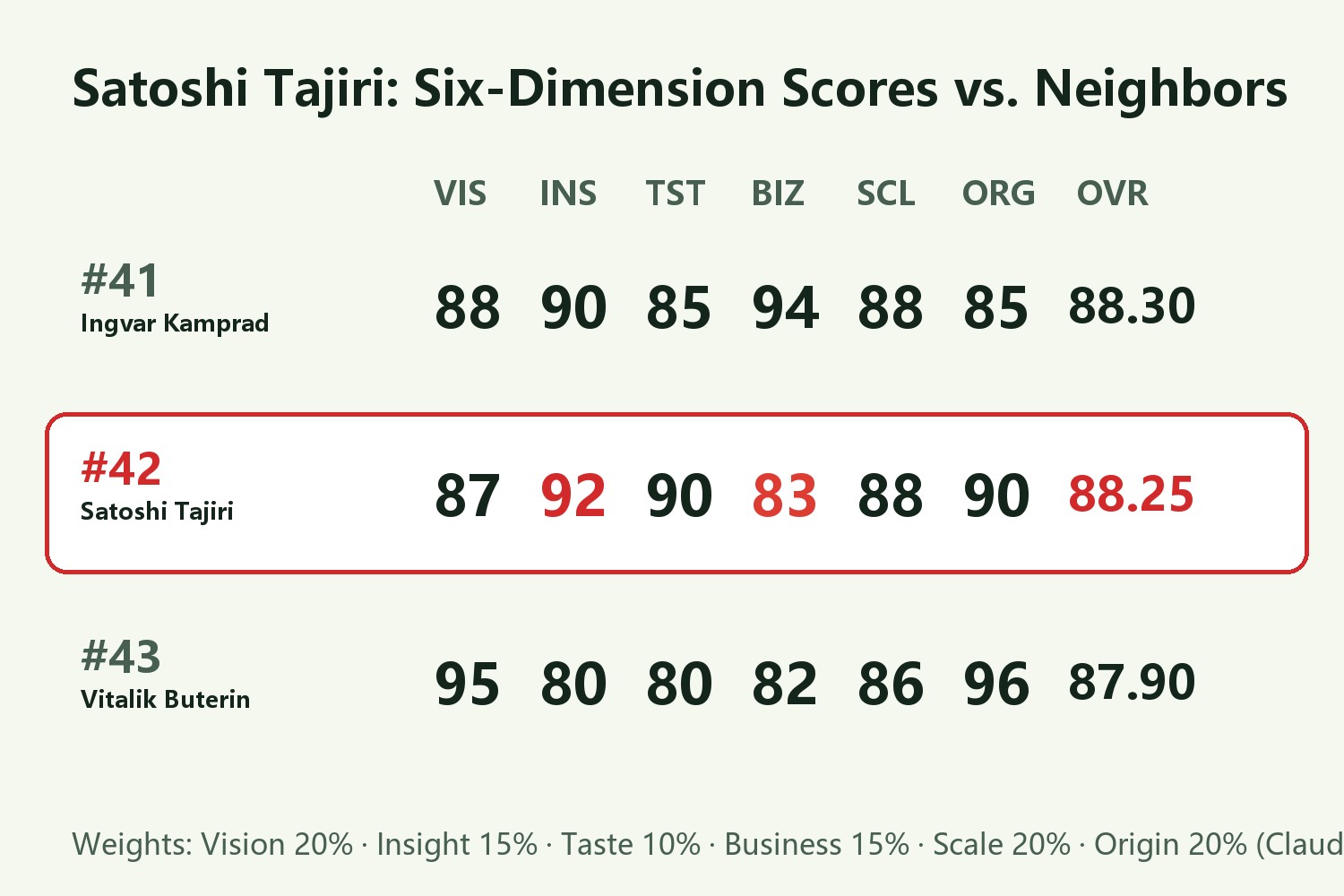
On our 100 Product Managers Who Changed the World leaderboard, Satoshi Tajiri ranks #42 with an overall score of 88.25 (evaluated by Claude AI across our six-pillar rubric): Insight 92, Taste 90, Originality 90, Scale 88, Vision 87, and Business 83.
He sits right behind #41 Ingvar Kamprad (IKEA founder, OVR 88.30) and #40 Satoshi Nakamoto (Bitcoin creator, OVR 88.35). Where Kamprad turned flat-pack furniture assembly into a weekend ritual, Tajiri decoded two of childhood’s deepest instincts: the taxonomy obsession of collecting every creature in the wild, and the social status of trading a rare find on the playground.
1. “Dr. Bug” Watches the Bulldozers Roll In: If the Forest Is Gone, Grow One Inside the Machine
Satoshi Tajiri was born in 1965 and raised in Machida, then a rural suburb on the western edge of Tokyo.
In the early 1970s, Machida had not yet been swallowed by Tokyo’s concrete sprawl. It was a world of oak groves, rice paddies, muddy ponds, and tall grass. Young Tajiri didn’t care much for baseball or classroom cliques. Every afternoon after school, he vanished into the trees with a net and a plastic specimen box, peeling back rotting bark for stag beetles or crouching beside rocks for rhinoceros beetles.
To catch rare nocturnal beetles, he even engineered his own traps—smearing fermented honey onto tree trunks and propping flat stones at precise angles so beetles could crawl in but not out. His classmates nicknamed him “Dr. Bug,” and he fully intended to become an entomologist.
Then Japan’s postwar urbanization bulldozers arrived.
By the late 1970s, Machida’s woods were felled acre by acre. The tadpole ponds were filled with concrete and turned into apartment blocks, parking lots, and noisy video arcades. Robbed of his forests, Tajiri wandered into the neon-lit arcades.
Standing in front of Space Invaders and Donkey Kong cabinets, the former insect collector applied the exact same observational rigor he had used in the woods: he mapped enemy movement patterns, spawn timers, and score tables pixel by pixel in notebooks.
In 1982, at age 17, Tajiri stapled together the first issue of a self-published arcade fanzine called Game Freak. That hand-lettered zine attracted a 16-year-old reader and watercolor illustrator named Ken Sugimori. In 1989, the two misfits turned their fanzine into a real game development studio of the same name.
All along, one question haunted Tajiri: City kids don’t have ponds or oak trees anymore. Can I build a video game that gives them the exact same heartbeat I felt when I flipped over a rock and saw a rare beetle?
2. A Six-Page Pitch and the Wire Nobody Knew How to Use
When Nintendo released the Game Boy in 1989 and Tajiri saw the Game Link Cable port on the side of the handheld, everything clicked into place.
Until that moment, every console RPG—from Dragon Quest to Final Fantasy—was a fundamentally solitary experience. You leveled up alone in front of your television, and your save file remained trapped forever inside your cartridge’s battery-backed SRAM.
Tajiri and Sugimori walked into Nintendo’s Kyoto headquarters with a pitch titled Capsule Monsters.
While big studios pitched hundred-page binders full of glossy artwork, Tajiri’s proposal was a rough sketch showing two children connected by a wire with monsters crawling between their machines. Most Nintendo executives were baffled: Isn’t an RPG supposed to be about slaying a Demon King? Why are two kids sending monsters over a wire?
Only one person in the room immediately understood the genius of the idea: Super Mario and Zelda creator Shigeru Miyamoto (#11).
Miyamoto, who had spent his own boyhood exploring caves and fields outside Kyoto, saw a kindred spirit in the 25-year-old Tajiri. He greenlit the project and signed on as Tajiri’s mentor and producer.
And it was Miyamoto who offered the hundred-billion-dollar product tweak:
“If you want kids to actually buy the Link Cable and trade with their friends, why release just one cartridge? Release two different colors at the same time—where certain monsters only appear in Red, and others only appear in Green.”
That single structural decision turned peer-to-peer trading from an optional minigame into a mandatory social loop (for a deep dive into how the dual-SKU mechanic reshaped the economics of gaming, read our #30 Product breakdown: Pokémon: Two Versions You Must Trade Between).
3. Six Years in Development Hell: Why Tajiri Refused to Let Monsters “Die”
From its greenlight in 1990 to its release in 1996, Pocket Monsters spent six grueling years in development hell, nearly bankrupting Game Freak multiple times.
Why did a 2D monochrome handheld game take six years? Because Tajiri was quietly rewriting the foundational rules of role-playing games:
1. Replacing “Death” with “Fainting”
In almost every 1990s RPG, defeating an enemy meant killing it—watching it dissolve into ash for gold and XP. Tajiri flatly forbade the concept of killing in Pokémon battles. No matter how hard a creature is hit, it only faints—and a quick trip to a Pokémon Center restores it to full health.
Tajiri’s reasoning was pure entomology: When kids catch beetles and pit them against each other on a log, they don’t want to murder their bugs—they respect them as companions. If you make players slaughter creatures on screen, you destroy the emotional bond required to name them, collect them, and trade them with friends.
2. Building an Ecological Coordinate System Inside 512 Kilobytes
Instead of scaling monsters linearly by dungeon level, Tajiri designed the 151 creatures of the Kanto region (modeled directly on the Greater Tokyo Area where he grew up) like a living field guide:
- Right outside Pallet Town in Viridian Forest, players encounter Caterpie and Weedle—larvae that evolve into Metapod and Butterfree at very low levels (Level 7 and Level 10). Tajiri placed them there deliberately as a 30-minute tutorial so every child could experience the magic of metamorphosis right at the start of the game.
- Deep inside Mt. Moon or the abandoned Power Plant, rare creatures lurked at 1% to 5% encounter rates—tuned to the exact dopamine sweet spot where kids would whisper rumors to each other at recess.
Cramming 151 distinct sprites, cries, stat tables, and serial link-cable protocols into a tiny 4-Megabit (512 KB) Game Boy ROM nearly broke the studio. Around 1993, Game Freak ran out of cash, five programmers walked out, Tajiri went months without taking a salary while living off his father’s savings, and the project only survived thanks to work-for-hire puzzle games (Yoshi and Mario & Wario) and technical rescue work from a brilliant young programmer named Satoru Iwata (#35).
4. The 300-Byte Ghost at #151 That Lit the Schoolyard Fire
When Pokémon Red and Green launched in February 1996, first-week sales were modest. Sony’s PlayStation (#31) and the Sega Saturn had already ushered in the 32-bit 3D era; few industry analysts believed kids in 1996 wanted a black-and-white RPG on a seven-year-old handheld.
Then a secret hidden in the final 300 bytes of the cartridge ignited the greatest word-of-mouth wildfire in gaming history.
Right before the master ROM went to manufacturing, after debugging tools were stripped out, exactly 300 bytes of free space remained. With Tajiri’s quiet nod, programmer Shigeki Morimoto slipped a secret 151st creature—Mew—into those final bytes.
The official manual listed 150 Pokémon. Mew was never meant to be encountered in the wild, and Nintendo’s marketing department didn’t even know it existed. Yet thanks to memory-overflow glitches in the early code, a handful of Japanese schoolchildren accidentally triggered wild Mew encounters.
Overnight, elementary school playgrounds across Japan erupted:
- “I swear my cousin saw #151 under the truck in Vermilion City!”
- “Who has a Mew? I’ll trade a Level 100 Charizard for it!”
Tajiri had recreated the exact urban-legend magic of his Machida childhood—when a rumor would spread through school that someone had spotted a giant golden stag beetle on an old oak tree behind the shrine. When CoroCoro Comic ran a mail-in contest offering 20 copies of Mew, the magazine received 78,000 postcards within days. Sales exploded exponentially, resurrecting the Game Boy and launching a global phenomenon.
5. Three Product Lessons from Satoshi Tajiri (OVR 88.25)
- The Biggest Product Breakthroughs Hide Where Everyone Else Sees Competition, and You See Connection Every other studio saw the Link Cable as a weapon for head-to-head combat. Tajiri saw it as a bridge for mutual exchange. When you design a product where no single user has 100% of the pieces—and connecting with a friend makes both sides richer—every user becomes an evangelist recruiting their friends into your network.
- Engineered Scarcity Builds Deeper Attachment Than Infinite Abundance Eleven missing creatures per cartridge, a strict six-slot party limit, choosing only one starter and one fossil—Tajiri understood that what you cannot have on your own is what gives value to what your friend holds.
- Translate Your Most Personal Lived Experience Into a Universal Mechanic Tajiri didn’t copy Western Dungeons & Dragons tropes of elves and broadswords. He took the smell of wet summer soil in Machida, the thrill of a shaking specimen box, and his grief over bulldozed forests, and translated them into tall grass and a Poké Ball wobbling three times. Every product that stays alive for thirty years has a real human childhood beating inside its code.
Related Reading
- Previous Rank (#41): Ingvar Kamprad: Selling Furniture Assembly as a Weekend Ritual
- Neighbor Rank (#40): Satoshi Nakamoto: Ship the White Paper, Let the Network Run, and Vanish
- Companion Product (#30): Pokémon: Two Versions You Must Trade Between
- Full Leaderboard: 100 Product Managers Who Changed the World
Discussion