Patrick & John Collison: Replacing Four Weeks of Banking Bureaucracy with Seven Lines of Code — How Two Teen Prodigies from Rural Ireland Built the Economic Infrastructure of the Internet
In early 2010 in Palo Alto, California, two baby-faced university dropouts with unmistakable Irish accents—21-year-old Patrick Collison and his 19-year-old brother John Collison—were staring at a laptop screen in disbelief.
They had been building small software side projects and wanted to do something that sounded trivial in the 21st century: accept a credit card payment on a website.
Instead of a clean software interface, they hit a medieval wall of financial bureaucracy:
- To accept a $20 payment online, a startup had to apply for a traditional merchant account with an acquiring bank, fill out dozens of pages of paper forms, fax utility bills, and wait three to four weeks for human underwriters to approve the application;
- Then they had to stitch that merchant account to a separate payment gateway, navigate PCI-DSS security compliance on their own servers, and decipher a 300-page PDF manual written in 1990s SOAP XML.
Patrick turned to John and asked a hundred-billion-dollar question:
“Why does it take one line of HTML to embed a high-definition video across the planet, but four weeks of paperwork and fax machines to move ten dollars? Why isn’t payments just an API you import in five minutes?”
A few months later, a tiny startup initially code-named /dev/payments—soon renamed Stripe—opened in a small Palo Alto storefront. The Collison brothers collapsed four weeks of banking bureaucracy into seven lines of code that any developer could copy, paste, and push to production tonight.
Today, Stripe processes over $1.4 trillion in annual payment volume—roughly 1.3% of global GDP. From OpenAI and Anthropic to Shopify, Amazon, and Uber, the financial bloodstream of the modern software and AI economy runs through the pipes built by two brothers from rural Ireland.
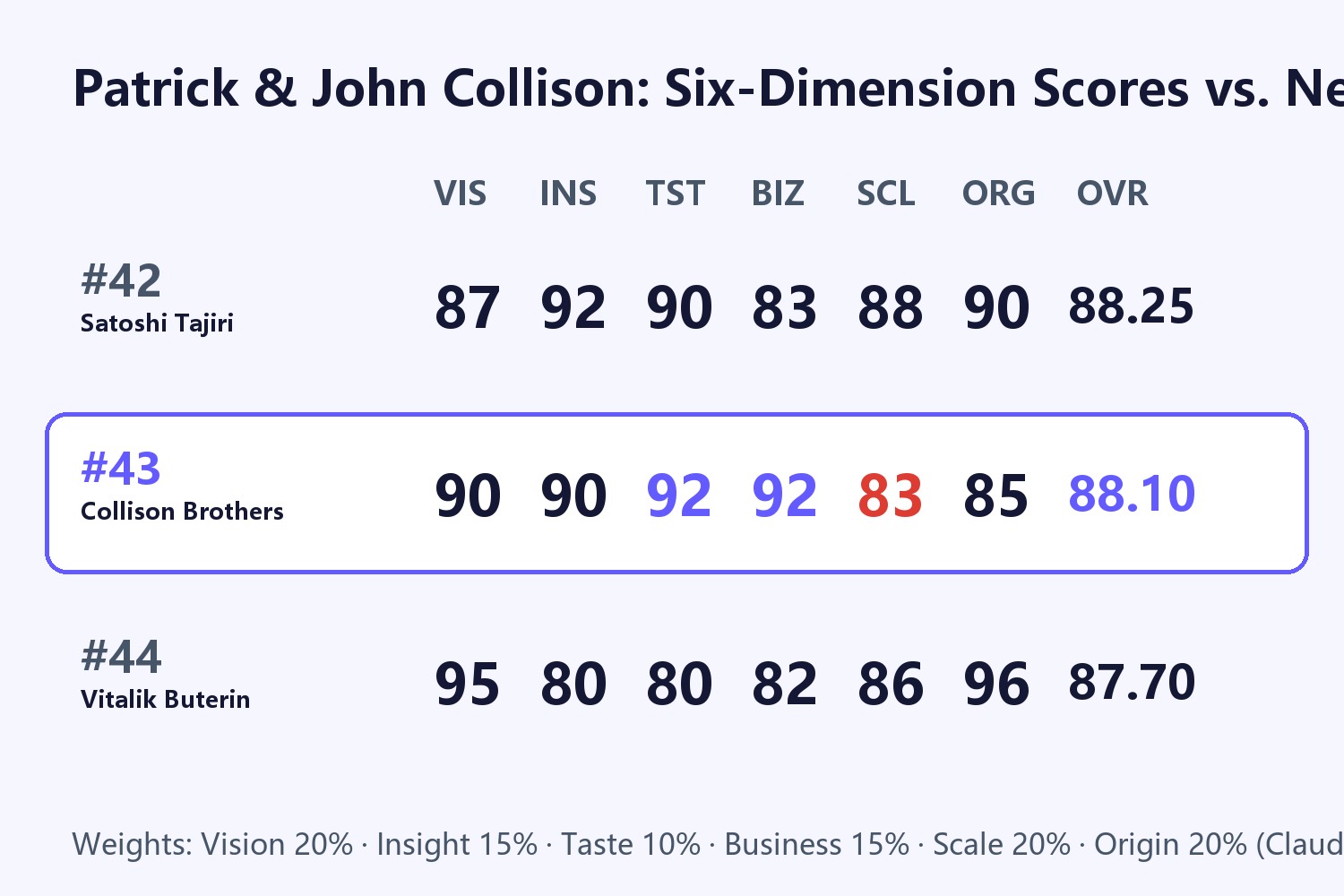
On our 100 Product Managers Who Changed the World leaderboard, Patrick & John Collison rank #43 with an overall score of 88.10 (evaluated by Claude AI across our six-pillar rubric): Taste 92, Business 92, Vision 90, Insight 90, Originality 85, and Scale 83.
They sit immediately after #42 Satoshi Tajiri (Pokémon creator, OVR 88.25) and #41 Ingvar Kamprad (IKEA founder, OVR 88.30). Where #40 Satoshi Nakamoto tried to route around the banking system with Bitcoin, the Collison brothers wrapped the world’s creaking banking rails inside the most elegant developer abstraction layer ever shipped.
1. Two Boys from a 100-Person Irish Village: Inventing a Lisp Dialect Before Broadband Arrived
Patrick (born 1988) and John (born 1990) grew up in Dromineer, a quiet lakeside village of roughly a hundred people in County Tipperary/Limerick, Ireland.
Their mother was a microbiologist turned entrepreneur and their father was an electrical engineer. With few kids their age nearby and no broadband internet in the countryside, the brothers spent their childhood reading stacks of books from the University of Limerick bookstore and teaching themselves to code:
- Patrick bought his first programming book at age 8 and began coding at 10. At age 16, he won Ireland’s prestigious BT Young Scientist and Technology Exhibition after building Croma, his own dialect of the Lisp programming language, and an accompanying AI system. Those credentials got him admitted straight into MIT a year early.
- John, determined not to be outdone by his older brother, sat for Ireland’s national Leaving Certificate exams at age 17 and achieved eight A1 grades—the highest score ever recorded in the history of the Irish state—before enrolling at Harvard University.
Before they could even legally drink in the United States, they had already built and exited their first startup.
In 2007, they built Auctomatic, a software tool for eBay power sellers, got accepted into Y Combinator, merged with a Canadian firm, and sold the company in March 2008 for $5 million—making Patrick a millionaire at 19 and John a millionaire at 17.
2. The “Collison Installation”: How to Cold-Start a B2B Empire Laptop by Laptop
When the brothers dropped out of MIT and Harvard in 2010 to build Stripe, most Silicon Valley investors thought they were crazy.
PayPal had already existed for a decade, backed by eBay’s balance sheet. Peter Thiel and Elon Musk—two of PayPal’s own co-founders—actually invested in Stripe’s seed round precisely because they knew better than anyone that PayPal had never fixed the underlying developer experience.
PayPal was built for consumers and corporate treasurers; its checkout flow hijacked users away from the merchant’s website, and its APIs were a tangle of legacy endpoints.
The Collison brothers realized a profound shift was underway in enterprise software: in a world where startups were founded by two engineers in a dorm room, the person choosing the payment infrastructure wasn’t a 50-year-old CFO—it was the programmer writing the checkout page at 2 a.m.
To sign up their first hundred users among Y Combinator founders, Patrick and John invented a tactic that YC founder Paul Graham famously christened the “Collison Installation”:
Polite founders pitch beta users by saying, “Here’s a link to our beta—let me know when you get a chance to try it.” And busy founders never click the link.
The Collisons didn’t send links. When they met a founder who needed payments, Patrick would say:
“Give me your laptop right now.”
He would take the founder’s keyboard, type gem install stripe, paste the seven lines of JavaScript and Ruby, and have live credit card processing running in production before the coffee got cold.
3. Why Developer Documentation Scored a 92 in “Taste”
Look at the Collison brothers’ six-pillar breakdown: Taste 92 and Business 92.
How does a backend financial plumbing company earn a 92 in product taste—a score usually reserved for consumer icons like Apple or Instagram?
Because Stripe treated API ergonomics and documentation as a first-class design discipline:
- The Three-Column Interactive Docs: Before Stripe, API documentation meant downloading a sterile PDF or clicking through nested JavaDoc tables. Stripe pioneered the now-ubiquitous dark-mode right pane where code snippets in cURL, Ruby, Python, Node, and Go update live alongside human-readable explanations—automatically pre-populated with your own logged-in test API keys so you could copy and run a working request in five seconds.
- Absorbing Regulatory Complexity Underwater: To make those 7 lines of code work on the surface, Patrick and John spent two years negotiating with Wells Fargo, credit card networks, and financial regulators to build automated instant underwriting. Stripe took on the fraud modeling, PCI compliance, and bank settlement reconciliation so the developer never had to see the ugliness of the legacy financial system.
- Compounding with Every Customer’s Growth:
By pricing transparently at
2.9% + 30¢per successful card charge, Stripe aligned its revenue directly with the GDP of the internet. A two-person YC startup that pasted Stripe’s 7 lines of code in 2012 (like Instacart, DoorDash, Shopify, or OpenAI) grew into a multi-billion-dollar enterprise without ever ripping out its payment spine—and then adopted Stripe Connect, Stripe Billing, Stripe Radar, and Stripe Tax.
4. Three Product Lessons from the Collison Brothers (OVR 88.10)
- Sell to the Builder, Not the Gatekeeper Legacy B2B companies built clunky software because they sold to executives who never had to use the product. By building an experience so joyful that engineers evangelized it on Hacker News, Stripe conquered the enterprise from the bottom up.
- Compressing Time-to-First-Value From Weeks to Minutes Changes the Market Size Cutting onboarding from four weeks to five minutes didn’t just win market share from existing gateways—it enabled millions of internet businesses, creator tools, and micro-SaaS products that previously wouldn’t have bothered incorporating.
- Documentation Is the User Interface of an API Product If your product is code, your error messages, SDK naming conventions, and quickstart guides are your industrial design.
Related Reading
- Previous Rank (#42): Satoshi Tajiri: Putting a Childhood Forest Inside a Link Cable
- Neighbor Rank (#41): Ingvar Kamprad: Selling Furniture Assembly as a Weekend Ritual
- Neighbor Rank (#40): Satoshi Nakamoto: Ship the White Paper, Let the Network Run, and Vanish
- Full Leaderboard: 100 Product Managers Who Changed the World
Discussion