The Gillette Safety Razor: Sell the Handle Cheap, Sell the Blades Forever — How a 40-Year-Old Bottle-Cap Salesman Wrote the Pricing Playbook for Printers, Consoles, and Coffee Pods
In 1903, a tiny Boston workshop finally shipped the product its founders had spent eight years obsessing over: a T-shaped metal handle that clamped a paper-thin, double-edged strip of stamped steel.
Across that entire first year on the market, 51 razors were sold in the United States, along with 168 extra blades.
Barbers and blacksmiths laughed. For centuries, shaving meant either sitting in a barber’s chair while a professional drew a forged “cut-throat” straight razor across your neck, or spending twenty minutes every morning stropping and honing a heavy steel blade at home. Who on earth would shave with a flimsy piece of sheet metal—and then throw the steel into the trash instead of sharpening it?
Fourteen years later, in 1917, Gillette sold 120 million blades in a single year.
Even more enduring than the hardware was the pricing architecture it introduced. Every time you buy a cheap HP inkjet printer and pay $60 for ink cartridges, every time Sony sells a PlayStation (#31) at a hardware loss to collect software royalties, and every time you pop an aluminum Nespresso pod into a machine, you are living inside the economic formula King Camp Gillette and William Nickerson built in 1901.
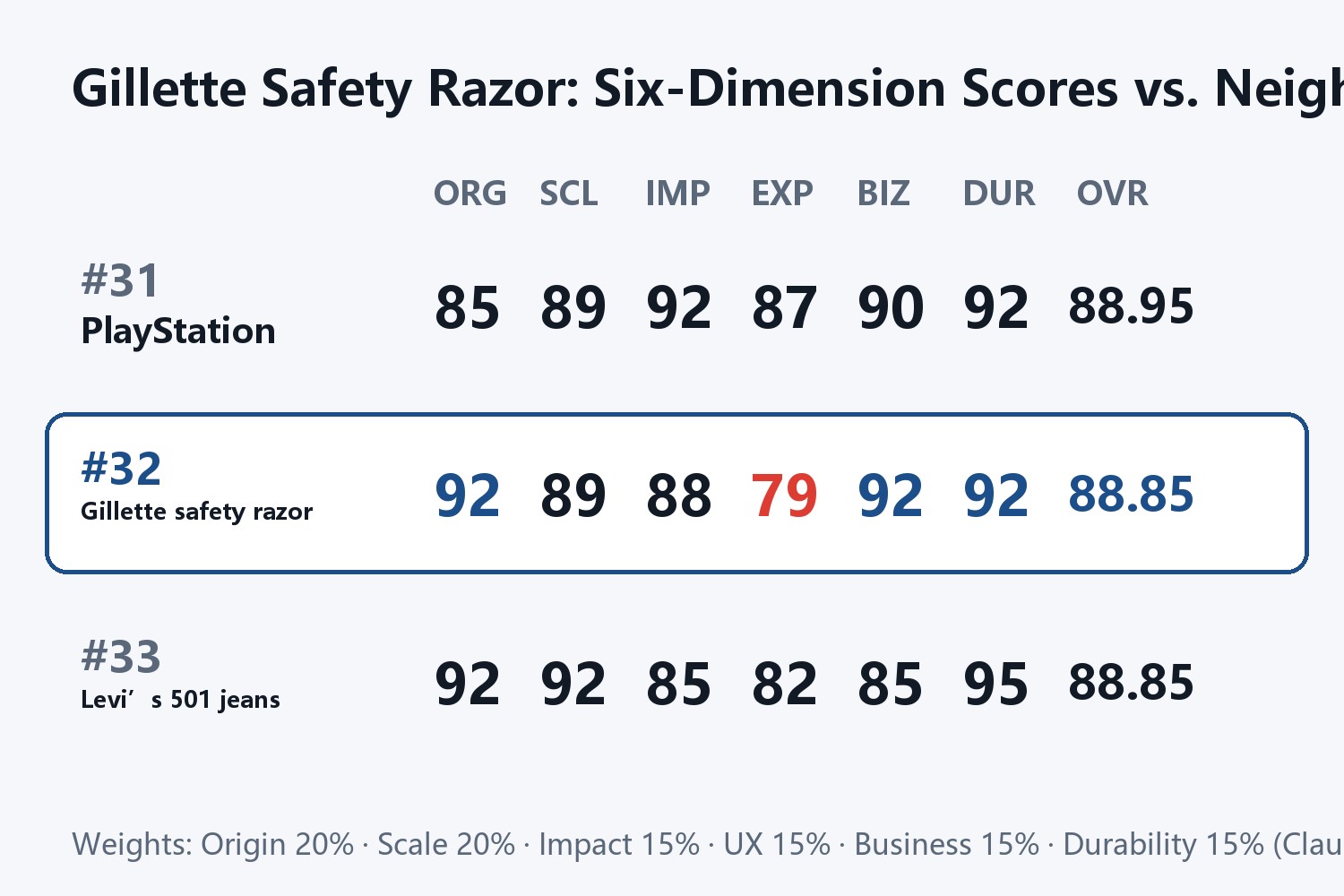
On our 100 Products That Changed the World ranking, The Gillette Safety Razor (1901) ranks #32 with an overall score of 88.85 (evaluated by Claude AI across six weighted dimensions): Originality 92, Business 92, Durability 92, Scale 89, Impact 88, and Experience 79.
It sits right behind #31 PlayStation (OVR 88.95) and ties at 88.85 with #33 Levi’s 501 Jeans (1873). Placing #31 PlayStation and #32 Gillette side by side highlights a century-long thread in product strategy: Ken Kutaragi’s willingness to subsidize console hardware in 1994 to capture high-margin disc sales is the exact descendant of Gillette’s Razor-and-Blades Model.
1. Advice from the Bottle-Cap King: “Invent Something People Use Once and Throw Away”
For the first forty years of his life, King Camp Gillette was a textbook struggling traveling salesman.
Born in Wisconsin in 1855, his family lost everything in the Great Chicago Fire of 1871. Gillette spent two decades living out of suitcases on sleeper trains, peddling hardware supplies by day and tinkering with failed inventions by night.
In the early 1890s, he went to work for William Painter, the Baltimore machinist who had just invented the Crown Cork—the crimped, disposable tin bottle cap still used on beer and soda bottles today.
Watching Gillette waste his evenings designing complex contraptions that customers would only ever buy once, Painter gave him a piece of product advice that changed business history:
“King, you are always thinking of inventing something, but you should invent something like the Crown Cork, which, when once used, is thrown away, and the customer keeps coming back for more—and with every additional customer you get, you are building a permanent foundation of profit.”
One morning in 1895, a 40-year-old Gillette stood in front of his mirror to shave and found his straight razor dull beyond stropping. It needed to go to a cutler or barber to be honed.
As he stared at the heavy blade in his hand, the insight struck: the only part of a razor that actually shaves your face is the microscopic 1-millimeter edge at the very tip. The rest of that thick, expensive forged steel existed only to hold the edge rigid.
What if you stamped that edge out of a wafer-thin ribbon of cheap sheet steel, sharpened both sides, clamped it between two brass plates so only a safe fraction of a millimeter was exposed, and threw the blade away when it got dull?
2. Six Years of “Impossible”: Why MIT Metallurgists Laughed—Until William Nickerson Showed Up
Gillette built a crude brass prototype in his kitchen, but for the next six years (1895–1901), every cutler, toolmaker, and metallurgist he consulted—including experts trained at MIT—told him the same thing:
“It cannot be done. Sheet steel thin enough to flex will warp and shatter like glass when you heat-treat it; and if you don’t harden it, it won’t hold an edge sharp enough to cut a single whisker.”
Gillette was nearly broke when he partnered in 1900 with William Emery Nickerson, an MIT-educated chemist and brilliant mechanical engineer who had previously designed vacuum pumps for incandescent lightbulbs.
Nickerson solved what traditional blacksmiths couldn’t by inventing automated mass-production machinery for thin steel:
- Clamped Hardening: By clamping the 0.15mm carbon-steel ribbon tightly between heat-conducting plates during tempering, Nickerson prevented the thin metal from buckling or warping.
- Automated Continuous Grinding: He built rotary sharpening machines that fed ribbons of steel through precision grinding wheels, putting a razor-sharp double bevel on both edges for pennies.
When the US Patent Office granted Patent #775,134 in November 1904, it locked in a crucial structural moat: the famous three-hole blade geometry. Because the flexible blade required Gillette’s proprietary three-pin clamping handle to bend it at the exact shaving angle, competitors couldn’t sell replacement blades that fit Gillette handles until the patent expired.
3. World War I and 3.5 Million Soldiers: The Ultimate Hardware Seeding Campaign
At first, Gillette actually charged a premium for the handle—$5 (roughly $170 today, or half a week’s wages for a working man)—Positioning it as a luxury time-saver against barbershop visits.
Then came World War I.
In 1917, as the United States entered the war, soldiers in the trenches faced a life-or-death problem: mustaches and heavy beards prevented gas masks from sealing tightly against the face during poison-gas attacks. Yet shaving with an exposed straight razor in a muddy trench was a recipe for slit throats and infection.
Gillette saw the opportunity of a lifetime and struck a deal with the US War Department to supply every American doughboy with a field-issue Gillette “Khaki Set.”
By the time the war ended in 1918, the US military had purchased 3.5 million Gillette razors and 36 million blades and placed them into the hands of young men from every town in America.
It was the greatest customer-acquisition subsidy in history:
- Millions of young men who had never shaved themselves before were trained by army sergeants to use a Gillette safety razor every single morning;
- When those 3.5 million soldiers came home in 1918, they kept their army-issued handles in their bathroom cabinets—and spent the next fifty years buying high-margin packs of Gillette replacement blades at their local drugstore.
When Gillette’s original patents finally expired in the 1920s and 1930s, the company leaned all the way into the model the world now names after it: giving away handles at cost—or free bundled with toothpaste, shaving cream, and bank accounts—to lock tens of millions of men into a lifetime blade annuity.
4. Why Experience Is 79 While Business and Durability Are 92
In our six-dimension scoring, Gillette earns 92 in Originality, 92 in Business, and 92 in Durability, while Experience sits at 79.
That 79 reflects the double-edged sword of the Razor-and-Blades model over a century. What began in 1901 as a genuine liberation from the straight razor eventually morphed into relentless cartridge inflation—from two blades (Trac II, 1971) to three (Mach3, 1998) to five (Fusion, 2006)—driving replacement cartridge prices so high that pharmacies had to lock them behind security glass, ultimately inviting disruption from Dollar Shave Club and Harry’s.
Yet the underlying architecture King Camp Gillette and William Nickerson built in Boston remains one of the five most influential business models ever conceived: subsidize the durable entry point, own the proprietary interface, and monetize the daily habit.
Further Reading
- 100 Products That Changed the World (Full Ranking)
- 100 Product Managers Who Changed the World (Full Ranking)
- PlayStation (#31): How a $1 CD-ROM Toppled Nintendo’s Empire
- Ingvar Kamprad (#41): Selling “Turning Screws” as a Weekend Ritual
- Pokémon (#30): Turning a Link Cable into History’s Highest-Grossing IP
Discussion