I Scored 99 Products. Adding One Attribute Called Durability Knocked the Ford Model T Down to 46th
The Ford Model T ranks 46th on the product board I just finished scoring.
The car launched in 1908, sold 15 million units in nineteen years, and turned the automobile from a rich man’s toy into something a worker could afford. Across my six attributes it scores: originality 97, impact 99, scale 94, business 95 — four numbers near the top of the entire board.
Two other numbers pull it down: experience 72, durability 62.
It went out of production in 1927. Today you can only see one in a museum.
The hardest of the six attributes was the sixth
Last year I built a product manager board with six attributes: vision, insight, taste, business, scale, originality. Scoring products, the first five carried over more or less intact. The sixth had to be rewritten.
Here is what I settled on:
| Attribute | Weight | What it measures |
|---|---|---|
| Originality ORG | 20% | Did it define a category that did not exist |
| Scale SCL | 20% | How many people it reached or shipped to |
| Impact IMP | 15% | How much it changed its industry and what came after |
| Experience EXP | 15% | How good it is to actually use |
| Business BIZ | 15% | Earning power and soundness of the model |
| Durability DUR | 15% | How long it lived, and whether it is still in use |
The first five are unremarkable. Durability is the one I added.
Scoring people does not need it. A person gets one career, and retiring does not make their past judgment any worse. Products are different: a person who retires is still a great person, a product that is discontinued is just an exhibit.
Without that attribute, you get a result I cannot accept — the Walkman and the iPhone end up with nearly the same score. Those two things are in completely different situations: the iPhone is still on sale, and Sony ended production of the cassette Walkman in 2010.
Adding it dropped a row of classics down the board
The five that got hit hardest all share a shape: very high originality, very low durability.
| Product | Originality | Durability | Overall | Rank |
|---|---|---|---|---|
| Ford Model T | 97 | 62 | 87 | 46 |
| Famicom / NES | 92 | 58 | 84 | 73 |
| iPod | 88 | 55 | 84 | 74 |
| Sony Walkman | 95 | 50 | 84 | 75 |
| Game Boy | 88 | 55 | 84 | 76 |
That table is uncomfortable to look at. The Famicom pulled the entire game industry out of the 1983 Atari crash and it sits at 73rd. The iPod saved Apple and sits at 74th.
I did not adjust them. The attribute exists precisely so the board can say this out loud: these products are gone. The iPod was killed by the iPhone, the Walkman was killed by the iPod, the Famicom’s direct descendant is now called the Switch. Their influence is still here. They are not.
The other direction lifted a different set of things:
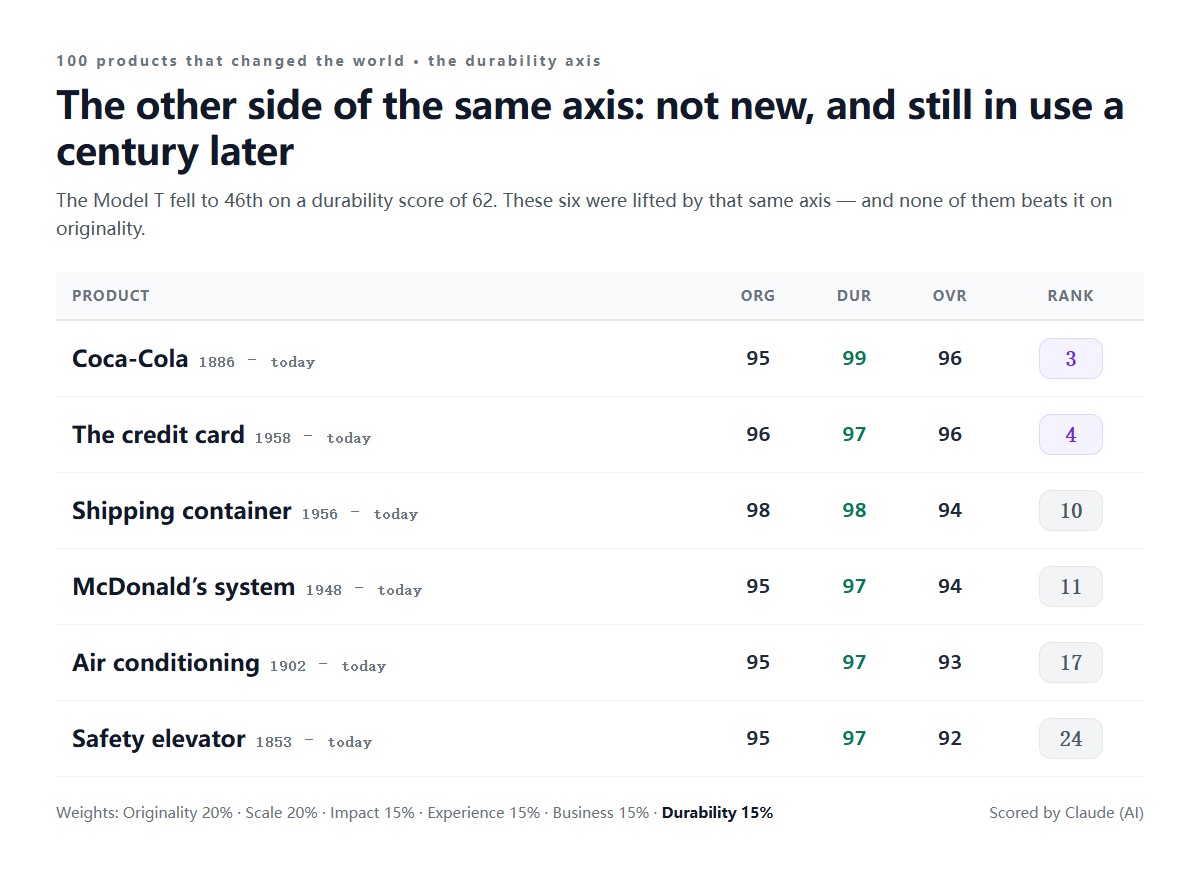
- Coca-Cola (3rd, 96) — 1886 to now, the formula barely changed
- The credit card (4th, 96) — in 1958 Bank of America airdropped 60,000 cards on the single city of Fresno, betting people would accept buy-now-pay-later
- The shipping container (10th, 94) — first voyage 1956; world trade still travels inside it
- The McDonald’s system (11th, 94) — that 1948 kitchen assembly line
- Air conditioning (17th, 93) — Carrier built it in 1902 to control humidity in a print shop
- The safety elevator (24th, 92) — built in 1853; the next year Otis cut the rope on stage at the New York Crystal Palace
What they share: not new, but not dead. They may not beat the Model T on originality, yet they survived a century and are still in use.
Only five products cleared 95, and two of them are not tech
I expected digital products to sweep the 95+ tier. After scoring, there are exactly five:
- iPhone 98
- Google Search 97
- Coca-Cola 96
- The credit card 96
- WeChat 95
A cup of sugar water and a piece of plastic, ranked above Windows (94), Amazon (94), AWS (94) and YouTube (94).
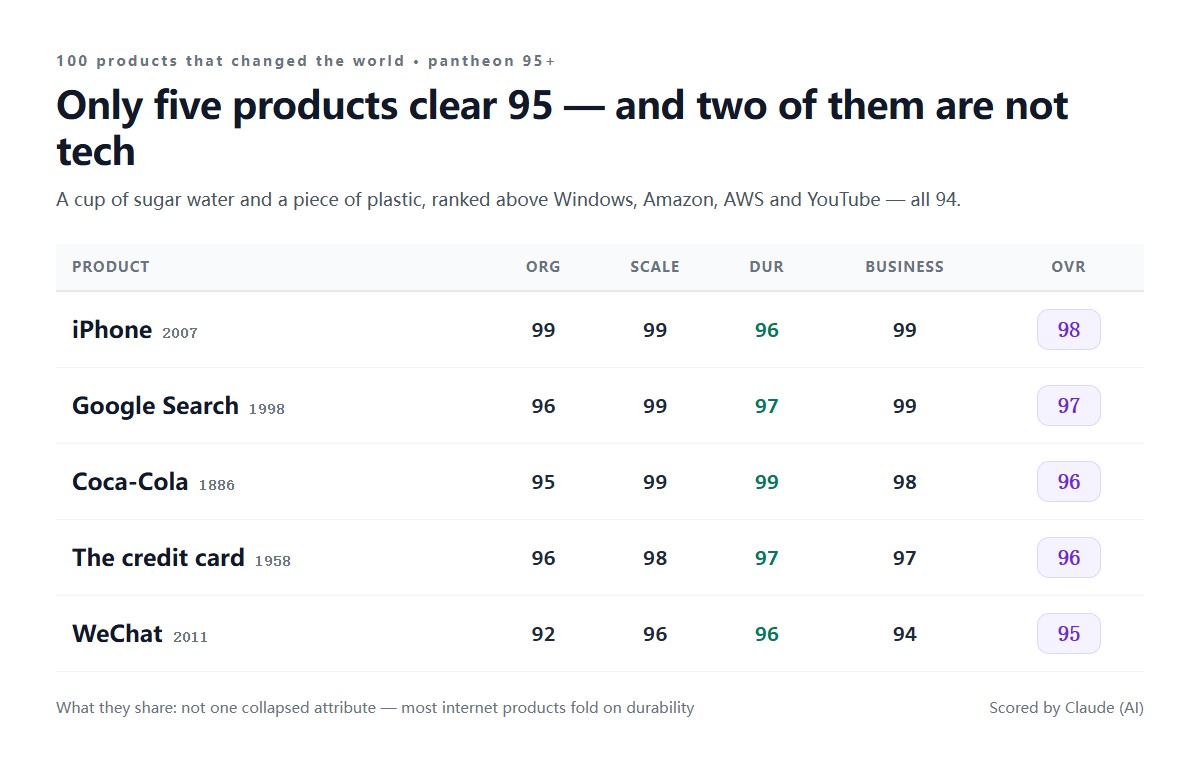
The reason is not complicated. Coca-Cola scores scale 99, durability 99, business 98. The credit card scores scale 98, impact 96, business 97. Neither has a single collapsed attribute, while most internet products fold on durability — software that survives twenty years is rare to begin with.
ChatGPT scores 93, and its durability is only 78
That is the most jarring number pair on the whole board.
ChatGPT’s originality 98 and impact 98 are both in the top group, with scale at 96. But it launched in November 2022, which is under four years, so durability is all I can give it at 78.
Under the same logic, GitHub Copilot scores 81 and ranks 98th, DeepSeek-R1 scores 80 and ranks 99th — two things I use every day, sitting at the bottom of the list.
This is not a claim that they do not matter. It is that durability does not let you borrow against time. If ChatGPT is still being used by a billion people in 2035, that number goes up and the overall score follows. The attribute was designed around one admission: part of the answer to whether a product is great can only be waited for, and until it arrives the score stays withheld.
The same person can be 44 places apart on the two boards
The product board and the people board are scored separately, and reading them against each other is where it gets interesting:
- Jobs is 1st on the people board (99) and his iPhone is 1st on the product board (98) — but the Macintosh only ranks 45th (88)
- Allen Zhang is 2nd on the people board (97); WeChat is 5th on the product board (95)
- Zhang Yiming is 5th on the people board; Douyin/TikTok is 16th and Toutiao is 87th
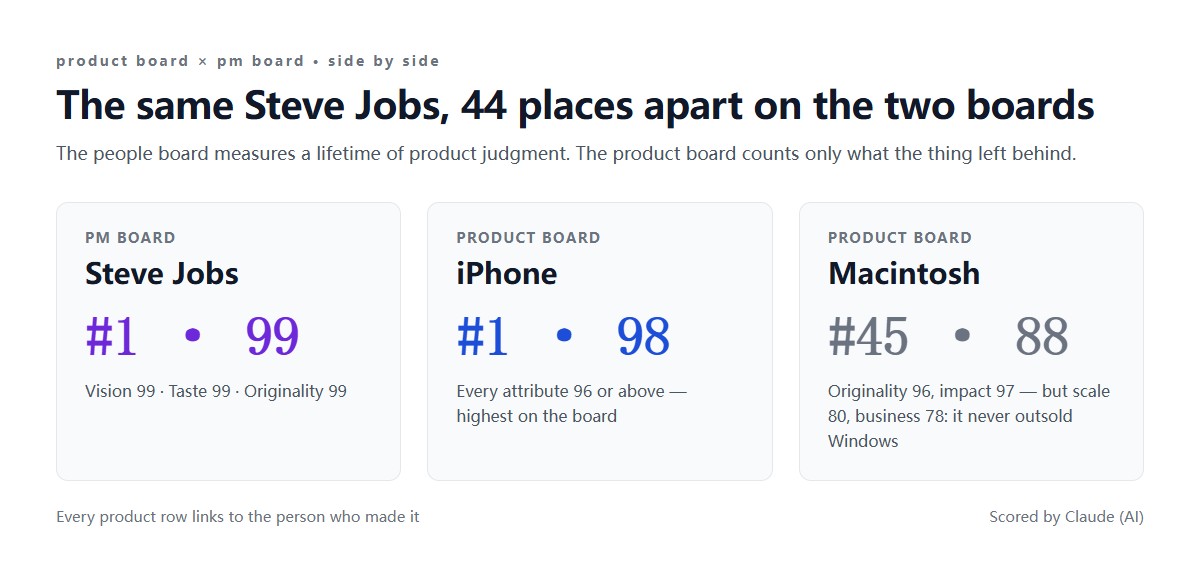
That is not a scoring error, it is two different questions. The people board measures a lifetime of product judgment — the Macintosh failed commercially, yet it defined the windows, icons and cursors everyone has looked at for forty years, and that judgment belongs to Jobs. The product board only counts consequences left in the world: the Macintosh lost to Windows, so its scale and business can only be 80 and 78.
The two boards are cross-linked. Where a product traces to a specific person, the row carries a “the person behind it →” link that jumps straight to their line on the people board.
What I left out: the Web, Wikipedia
This board only takes commercial products — things actually sold, or things someone actually ran a business on.
So the World Wide Web is not here. Wikipedia is not here. Signal is not here. It is the same rule the people board uses: Berners-Lee, Wikipedia’s founder and Signal’s author were all removed under it. The bar is “created a great product in the commercial world”, not “contributed most to humanity” — that would be a different board, and I am not making it.
One boundary is not clean, and I will own it: I kept the Linux kernel (47th, 86). It does not sell anything itself; I kept it because the distributions and the Android ecosystem built on top of it are real businesses. That call is arguable and I am happy to argue it.
I left the 100th seat empty
There are only 99 entries on the board.
The hundredth is reserved for a product that does not exist yet. That is not sentiment — the AI era is the first one where a person who can say clearly what they want can build it themselves, so the seat is genuinely fillable, possibly by whoever is reading this.
The method is published on the board page: each attribute 0–99, weighted into an overall score, ranked descending. All attribute scores and the ordering are produced by Claude (AI) — I set the attributes, the weights and the inclusion rule; Claude scores independently, and the numbers get adjusted as each deep-dive goes deeper. That is not modesty, it is assigning responsibility: if the board deserves a beating, it should be clear which part is being beaten.
After scoring all 99, the attribute I am least sure of is experience. I gave AirPods 92 and the Model T 72 — and those two numbers do not come off the same ruler: one I have held in my hand, the other is inferred across a century from other people’s accounts. I have not solved that. For now it stands.
Discussion