The iPhone Ranks First on My Board. On the Day It Shipped, It Couldn't Copy and Paste
The iPhone that went on sale on June 29, 2007 could not do any of the following:
Run a third-party app. Copy and paste text. Record video. Send a picture message. Connect over 3G.
It cost $499 for the 4GB model and $599 for the 8GB, and required a two-year AT&T contract. The BlackBerrys, Nokias, Windows Mobile devices and Palm Treos on sale at the same moment did most of those five things. Some did all five.
On the board where I scored 99 products, this machine ranks first, with an overall of 98.
Across six attributes, it lost exactly 6 points
| Attribute | Score | Basis |
|---|---|---|
| Originality ORG | 99 | Full-face capacitive touch plus a software keyboard; every phone since has this shape |
| Scale SCL | 99 | Cumulative units in the billions — Apple reported 1.47 billion through fiscal 2018, then stopped disclosing |
| Impact IMP | 99 | Nokia fell from nearly 50% to under 1%; BlackBerry from 43% to 0.0% |
| Experience EXP | 98 | See below — it has had a genuine experience disaster |
| Business BIZ | 99 | $196.5 billion in iPhone net sales across the first nine months of fiscal 2026, up 22.4% year over year |
| Durability DUR | 96 | Nineteen years old and still selling, but far short of Coca-Cola’s 140 |
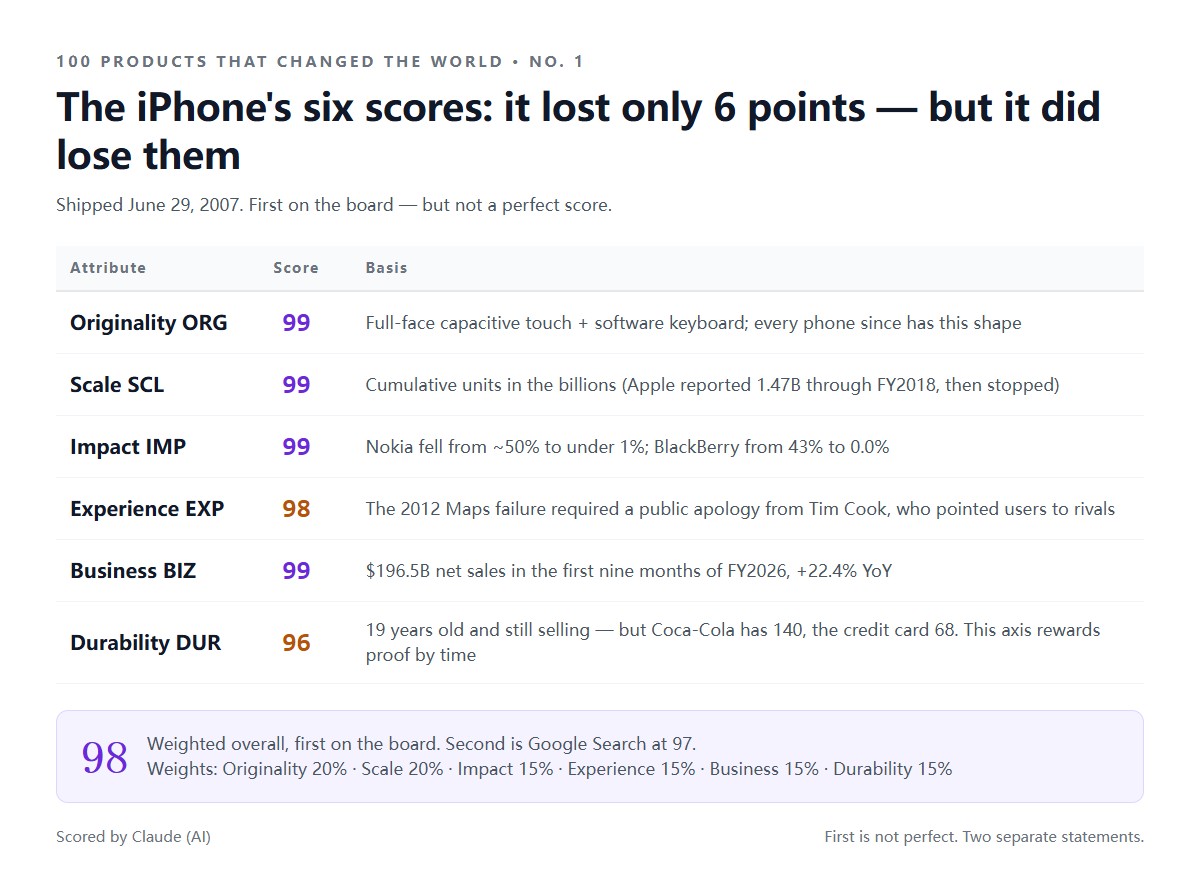
The two points off experience are not nitpicking. Copy and paste — that arrived two full years after the iPhone shipped, with the iPhone 3GS in June 2009, alongside video recording and MMS. The harder case came in 2012, when Apple replaced Google Maps with its own and the result was bad enough that Tim Cook published an apology letter, in which he suggested users try competitors’ maps in the meantime. A product scoring 99 on experience does not do that.
The three points off durability are a property of the dimension, not a grudge. That axis rewards having been proven by time. Coca-Cola has run 140 years, the credit card 68, the shipping container 70. The iPhone has had 19. It is in excellent health right now — it simply hasn’t been through what those other products have been through.
Everything the competition said at the time was factually correct
In 2007, then-Microsoft CEO Steve Ballmer laughed on camera and said the iPhone was “$500, fully subsidized with a plan,” calling it “the most expensive phone in the world,” and adding that it “doesn’t appeal to business customers because it doesn’t have a keyboard.” His conclusion: “There’s no chance that the iPhone is going to get any significant market share. No chance.”
Take the facts apart and every one of them checks out:
- It was indeed among the most expensive phones on the market
- It indeed had no physical keyboard
- It indeed had no advantage in enterprise — BlackBerry was the corporate standard then
- It was indeed selling badly: 68 days after launch, Apple cut the 8GB model from $599 to $399, a third off the price. Early buyers revolted, and Jobs issued a public apology plus a $100 store credit for every one of them
A product that has to cut its price by a third two months after launch, with the founder writing an apology letter, is not a good sign in anyone’s post-mortem. Nothing Ballmer observed was false.
What he got wrong was treating those facts as the ending. Every item on that list — too expensive, no keyboard, weak in enterprise, not selling — was fixable. Prices come down. Features get added. Enterprise gets infiltrated one employee-owned device at a time.
Jobs himself was wrong about the most important part
What makes the iPhone the iPhone today is the App Store. And the App Store was not in the original design. It was a reversal, forced on Apple.
At WWDC in June 2007, three weeks before the iPhone went on sale, the answer Jobs gave developers was web apps — write them with Web 2.0 and AJAX, run them in Safari. He called it the “sweet solution.” He did not intend to open the device to native third-party applications.
Developers didn’t buy it. The reaction was close to uniformly negative, and the jailbreak community proceeded to install native apps their own way.
Four months later, on October 17, 2007, Jobs posted an open letter on Apple’s Hot News page announcing an SDK. His words: “We want native third party applications on the iPhone, and we plan to have an SDK in developers hands in February.”
The SDK shipped in February 2008. The App Store opened on July 10, 2008.
As of January 2026, Apple’s published figure is that developers have earned more than $550 billion cumulatively from the App Store.
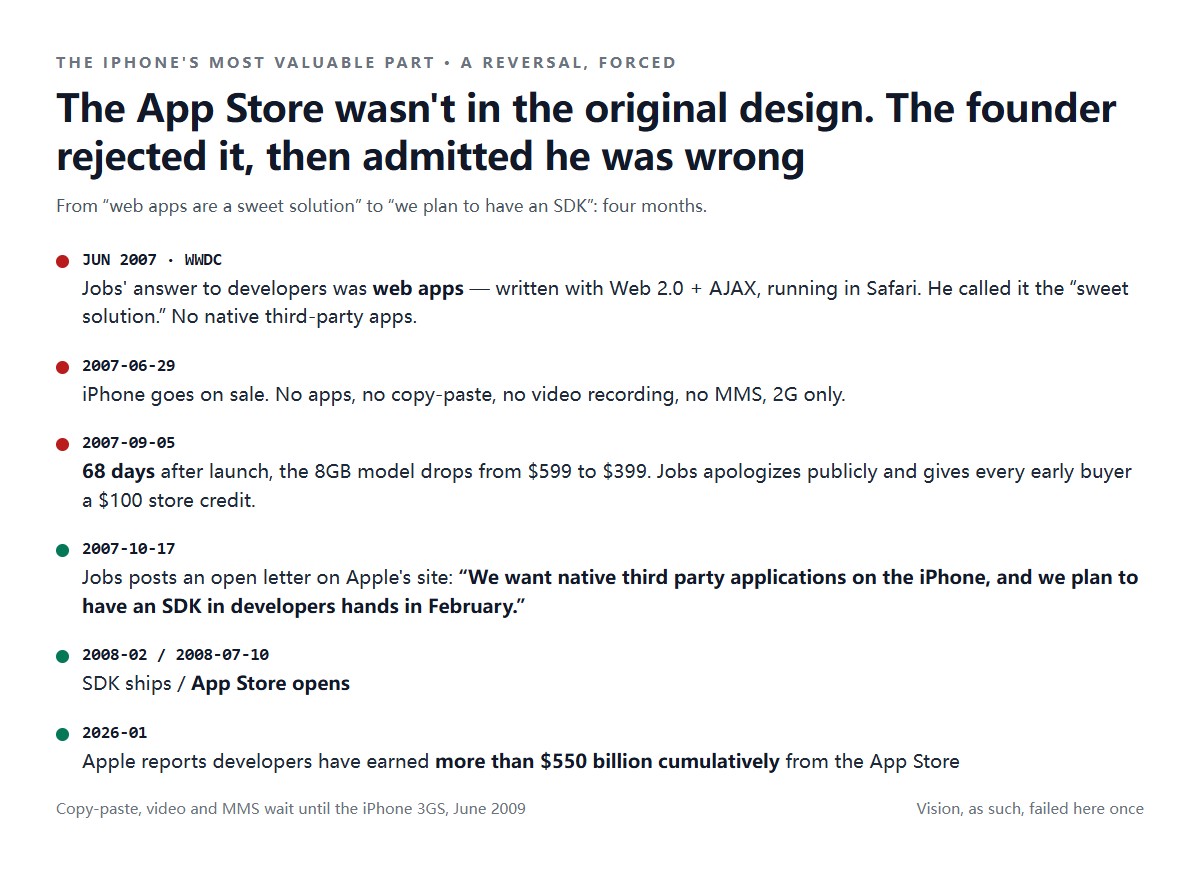
I find this more significant than those ninety minutes on stage. The single most valuable component of the number-one product on this planet is something the founder publicly rejected, and only built after users and developers pushed back.
Vision, as such, failed here once. What worked was something else: he admitted it. From publicly saying web apps were sweet enough, to publicly writing that an SDK was coming, took four months and change.
The one thing it got right was the one thing nobody could retrofit
String all that together and you land somewhere slightly counterintuitive: everything the iPhone got wrong in its first eighteen months was fixable.
Features got fixed — copy-paste two years late, MMS two years late, 3G one year late, all delivered. Price got fixed, in two months. The ecosystem got reversed, in four.
It got exactly one thing right: it deleted the physical keyboard, gave the entire front face to a capacitive multi-touch screen, and let software draw a keyboard only when one was needed.
That, the competition could not retrofit.
Because it isn’t a feature, it’s a shape. For Nokia or BlackBerry to follow was not a matter of adding a module or pushing a firmware update. It meant tearing down their entire product line, their supply chain, their software stack — and the identity at the center of all of it: our keyboards have the best feel in the world.
The numbers are blunt. Nokia held nearly half the phone market in 2007; its smartphone share fell below 5% by 2013 and under 1% by 2024. BlackBerry peaked at 43% in 2010 and has sat at 0.0% since 2016.
A product can get a lot of things wrong, as long as the thing it gets right is irreversible.
The inverse holds too, and it is the more useful half for anyone building things: you can lead on a dozen fronts, but if every one of those leads can be erased by a competitor’s next update, they don’t add up to a moat. What decides survival is whether there is one thing your rival would have to demolish himself to match.
Why 98, and not 99
Second on the board is Google Search, at 97. The point the iPhone has on it sits in originality and experience.
But I didn’t give the iPhone 99, for the two deductions above: a product that shipped a maps replacement in 2012 bad enough to require a CEO’s apology cannot reach full marks on experience; and a product that has lived 19 years, on a board that includes the 1853 safety elevator and 1886 Coca-Cola, has not yet earned full marks on durability.
It is first. First is not the same as perfect — those are two separate statements.
The method is published on the board page: each attribute 0–99, weighted into an overall, ranked descending. All attribute scores and the ordering are produced by Claude (AI) — I set the attributes, the weights and the inclusion rule; Claude scores independently, and numbers get tuned as each deep-dive goes deeper.
One question I’m leaving open after writing this: if nobody had pushed back on “web apps are a sweet solution” in June 2007, and the App Store had arrived three years later, would the iPhone still be first today. My instinct says no — but that judgment can’t be verified, so it stays a question.
Discussion